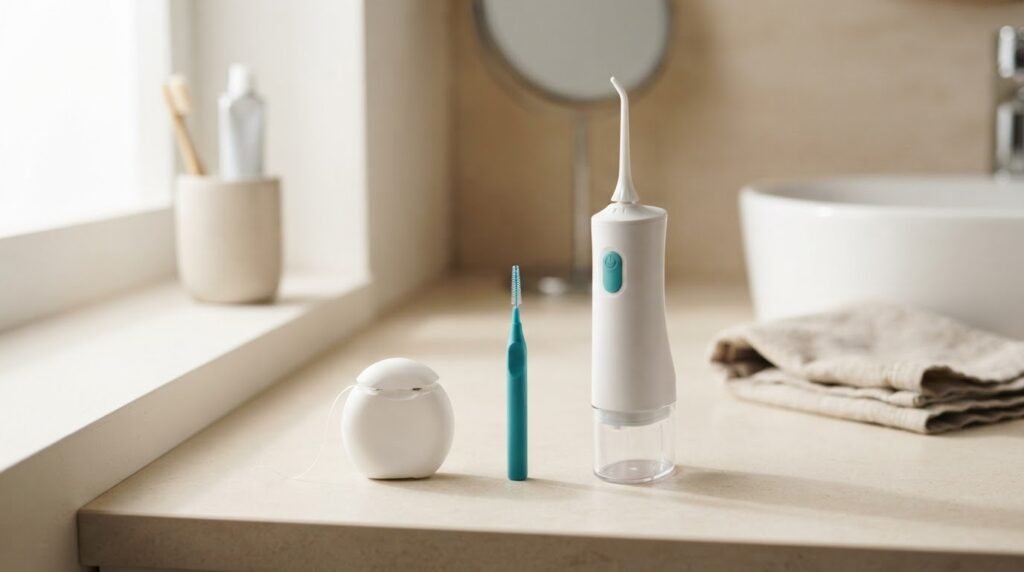
You brush your teeth every night, but the little box of floss sits untouched. Maybe the string slips from your fingers, or you can reach the front teeth easily and give up once you get to the back. The fiddly part is the tool. The job is to clean the surfaces where neighboring teeth meet, and there are several ways to do it.
The American Dental Association recommends cleaning between your teeth once a day, alongside brushing twice a day. Cleaning between teeth helps remove bits of food and plaque from areas a toothbrush has trouble reaching. Plaque is the sticky film of bacteria that builds up on teeth. The National Institute of Dental and Craniofacial Research says that adding floss or interdental brushes to brushing may help reduce plaque or gum inflammation.
If the string is hard to hold
A floss holder keeps a short length of floss stretched across a handle, so you can guide it without wrapping string around your fingers. With regular floss, the National Institute of Dental and Craniofacial Research illustrates how to curve the strand around one tooth and slide it gently up and down. Then curve it around the tooth on the other side of the same gap. Ease the floss through the contact between teeth so it doesn’t snap against your gums.
If you have a wider gap
An interdental brush is a tiny brush sized to slip between teeth. It can be easier to use where there’s room for the bristles to pass. Sizes vary, so if the brush catches or needs force, ask a dental hygienist which size to try. A hygienist can also show you options such as a floss threader if dental work makes a spot difficult to reach.
If you prefer a handle and a stream of water
A water flosser sends a narrow stream of water between teeth and along the gumline. The American Dental Association includes water flossers among the options for cleaning between teeth. If you try one, follow its instructions and give yourself time to learn how to aim it over the sink. Keep brushing as part of the routine.
Make the routine easy to repeat
Keep the tool beside your toothbrush and pick a time when you’re already at the sink. Start at the same back tooth and work around your mouth in order so you remember which gaps you’ve cleaned. If you always get stuck in one place, point it out at your next dental visit and ask for a quick demonstration. You may find that one tool is easier to use in tight spots and another fits the wider ones.
Further reading
- American Dental Association — Dental Floss and Interdental Cleaners. Compare the types of tools and see how daily cleaning between teeth fits into routine dental care.
- National Institute of Dental and Craniofacial Research — Oral Hygiene. See illustrated steps for using string floss and examples of other tools.
- National Institute of Dental and Craniofacial Research — Ask the Expert: Do I Really Need to Floss? Read what research says about removing plaque and why there’s more than one way to clean between teeth.