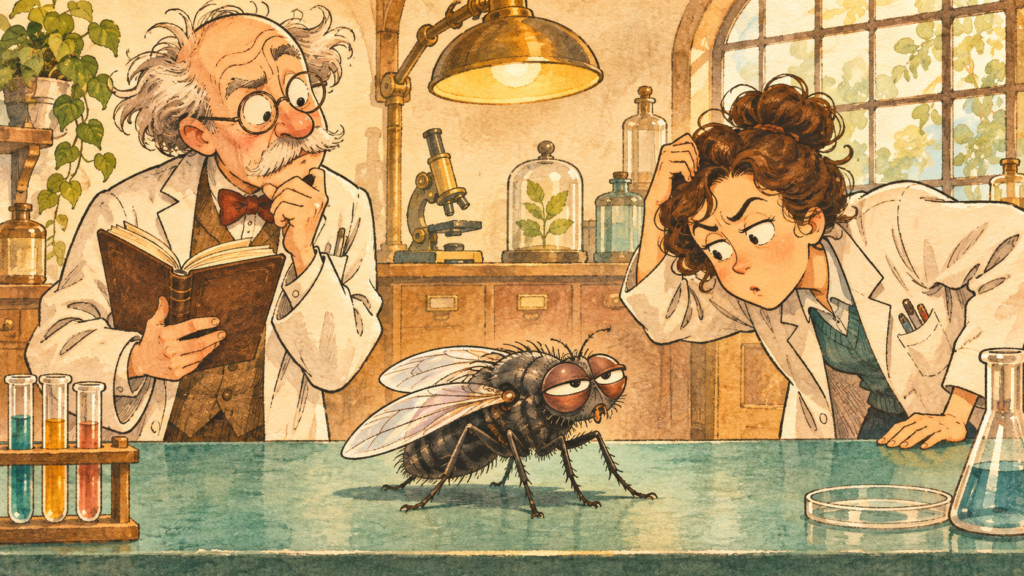
A scientist sets a fly on his lab bench, opens his notebook, and says, “Fly!” The fly takes off. He writes down what happened.
In the joke, the scientist removes the fly’s wings and gives the same command. “Fly!” This time the fly stays put. He tries again, a little louder. Still nothing.
He picks up his pen and writes, “When you remove a fly’s wings, it becomes deaf.” 🤣
The fly stayed put. What did that tell him?
We laugh because we can see what the scientist missed. He saw the fly stay on the bench. Then he decided he knew why. His experiment depended on the fly being able to do the very thing he’d just made impossible.
The fly’s lack of movement was an observation. The claim about its hearing was an interpretation. It’s easy to hear the difference when the story is about a fly. It’s harder when we’re reading a headline that confirms something we already believe.
Two things can happen together for several reasons
Imagine you start taking an evening walk and notice that you’re sleeping better. You might credit the walk. Then you remember you also started getting up at the same time every morning and putting your phone away earlier. You know how you slept. Figuring out what helped is a separate question.
That’s the everyday version of confusing correlation with causation. A pattern gives us something to investigate. The next step is to ask what else changed, what we actually measured, and what would help us tell one explanation from another.
When to look closer and when to step back
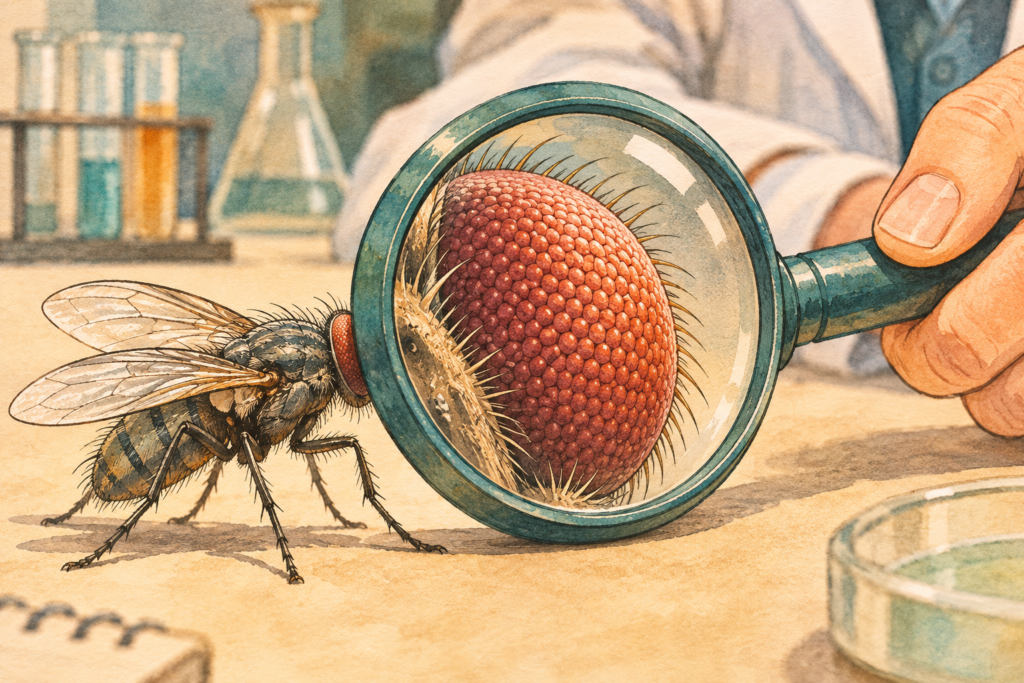
There’s real value in studying one detail carefully. A magnifying glass lets us see things we’d otherwise miss. I think the trick is to remember to put it down once in a while and look at what’s around it. In nature, health, and daily life, several things can be changing at once, and some of the most important ones may be outside the frame.
To me, common sense is what makes us pause before we write the conclusion in ink. The next time a headline says one thing causes another, try asking yourself, “What did they actually observe?” Then ask, “What else could explain it?” I wonder how different that scientist’s notebook would look if he’d asked himself those two questions.
Further reading
- Australian Bureau of Statistics — Correlation and causation. An introduction to the difference between two things being related and one causing the other.
- Cochrane Iberoamérica — Correlation does not imply causation. A one-page guide to spotting language in health headlines that overstates what a study found.
- CDC Field Epidemiology Manual — Analyzing and Interpreting Data. A closer look at how researchers consider alternative explanations such as chance, bias, and confounding.